
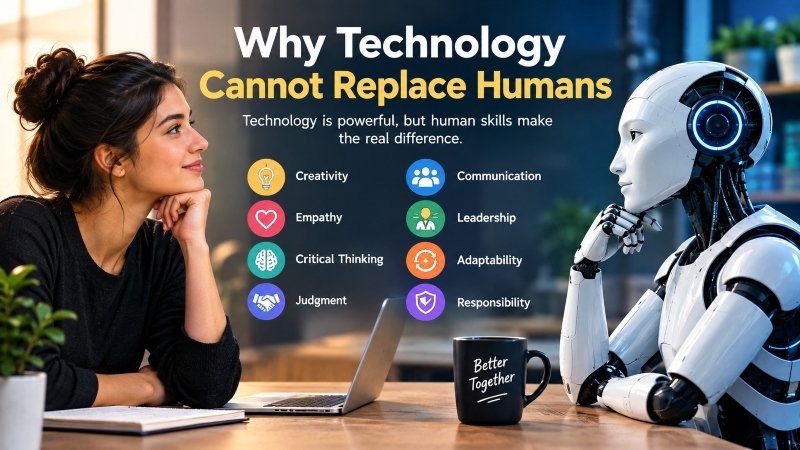
Technology has changed the way people live, work, communicate, and solve problems. Artificial intelligence, automation, and smart software can now perform many tasks that once required human effort. This progress has raised an important question: why technology cannot replace humans completely.
The answer is not that technology is incapable or unhelpful. Modern technology can process information, identify patterns, automate repetitive tasks, and produce results at remarkable speed. However, human intelligence involves much more than processing information. People can understand emotions, make judgments in uncertain situations, develop ideas from personal experiences, and take responsibility for their decisions. The future is therefore more likely to involve humans working alongside technology rather than technology completely replacing people.
Technology Is a Tool, Not a Complete Human Replacement
Technology is designed to perform specific functions. A computer can calculate numbers in seconds, while an AI system can analyze huge amounts of information much faster than a person. However, real-life situations are often complicated. They may involve emotions, personal relationships, ethical questions, and incomplete information.
For example, an AI system can analyze customer complaints and identify common problems. However, a human customer-service manager can speak with an unhappy customer, understand their frustration, consider the circumstances, and decide how to respond appropriately. This difference explains why technology cannot replace humans in every situation. Technology can provide information and assistance, but people often need to decide what that information means and how it should be used.
Human Skills Technology Cannot Fully Replace
There are several important human abilities that remain difficult to reproduce completely through technology.
| Human Skill | What Technology Can Do | Why Humans Remain Important |
|---|---|---|
| Creativity | Generate ideas and content | Humans provide personal experiences and original perspectives |
| Empathy | Detect emotional patterns | Humans understand emotions through relationships and experience |
| Critical Thinking | Analyze data and identify patterns | Humans question assumptions and consider context |
| Judgment | Provide recommendations | Humans consider values, consequences, and responsibility |
| Communication | Generate and process language | Humans build trust and meaningful relationships |
| Leadership | Analyze information | Humans motivate, guide, and inspire people |
| Adaptability | Follow programmed or learned patterns | Humans can respond to unexpected circumstances |
| Moral Reasoning | Apply predefined rules | Humans can consider ethical and social consequences |
These differences do not mean technology has no role in these areas. Instead, they show why human involvement remains important.
1. Empathy Requires Human Connection
One of the strongest reasons technology cannot replace humans is empathy. AI can recognize words associated with emotions such as happiness, sadness, or anger. It can also generate responses that sound sympathetic. However, recognizing an emotional pattern is not the same as experiencing human emotions or developing genuine relationships.
Consider a doctor speaking with a worried patient. Technology can help the doctor examine medical information, identify patterns, or organize records. Yet the doctor must also listen to the patient, understand their concerns, explain information clearly, and provide reassurance. The human relationship can be an important part of the experience. Research from the OECD also highlights social and emotional skills, communication, teamwork, and problem-solving as important capabilities in modern workplaces.
2. Creativity Goes Beyond Generating Content
Modern AI can generate articles, images, music, videos, and computer code. Because of this, some people assume that technology can completely replace human creativity. However, creativity is not simply about producing something new.
Human creativity often comes from personal experiences, emotions, curiosity, culture, and observations about the world. A person may develop a new product because they experienced a problem themselves. An artist may create something because of a personal memory or emotion. AI can help people explore ideas and create different versions of their work. However, humans can provide the purpose, direction, and personal meaning behind creative projects. This makes collaboration between people and technology particularly useful.
3. Critical Thinking and Human Judgment Matter
Technology can analyze large datasets and identify patterns, but data does not always provide a complete answer. Imagine a business owner deciding whether to launch a new product. An AI system could analyze competitors, customer behavior, market trends, and financial information.
That information could be extremely useful. However, the final decision might also depend on the company’s reputation, long-term goals, employees, customers, and ethical considerations. A human decision-maker can consider these factors together and take responsibility for the final choice. The National Institute of Standards and Technology (NIST) emphasizes the importance of human oversight and managing risks when AI systems are used. NIST AI Risk Management Framework
4. Humans Can Handle Unexpected Situations
Technology usually operates according to its programming, training, available information, and operating conditions. Humans can also learn, but they have another important ability: they can respond creatively when something unexpected happens.
For example, an experienced mechanic may discover an unusual vehicle problem that does not exactly match the information in a diagnostic system. The mechanic can use experience, observation, reasoning, and experimentation to identify a possible solution. Similarly, entrepreneurs, engineers, researchers, and other professionals regularly face problems that do not have straightforward answers. Technology can assist them, but human adaptability remains important.
5. Humans Provide Accountability
Another important reason why technology cannot replace humans is responsibility. When an important decision affects other people, someone needs to be accountable for that decision.
For example, an organization might use an algorithm to help evaluate applications or identify unusual transactions. If the system produces an incorrect result, human professionals may need to investigate what happened, determine whether the system was used appropriately, and decide what action should be taken. AI can support decision-making, but responsibility still belongs to people and organizations. This is one reason responsible technology requires clear human oversight and governance.
Technology Will Change Jobs, Not Simply Remove People
It would be unrealistic to say that technology will have no effect on employment. Automation and AI are already changing the tasks people perform. Some repetitive activities can be automated, while other jobs may require new skills. At the same time, technology can create demand for new roles and new types of expertise.
The World Economic Forum’s Future of Jobs Report 2025 identifies technological change as a major driver of workplace transformation and highlights skills such as creative thinking, resilience, flexibility, and agility alongside technological skills. World Economic Forum — Future of Jobs Report 2025 This suggests that the important question is not simply whether technology will replace humans.
A better question is:
How can humans use technology to become more productive and capable?
The Future Is Human and Technology Working Together
Instead of viewing technology and humans as competitors, businesses can use them as partners. Technology can handle repetitive calculations, data processing, information retrieval, and routine operations. Humans can focus on strategy, communication, creativity, leadership, judgment, and relationships.
For example:
- Doctors and AI: AI can help analyze information while doctors communicate with patients and make professional decisions.
- Teachers and technology: Digital tools can support personalized learning while teachers provide guidance and encouragement.
- Designers and AI: AI can generate design ideas while designers establish the creative direction.
- Business leaders and analytics: Technology can identify trends while leaders decide how to respond.
- Writers and AI: AI can assist with research and drafting while writers provide originality, voice, and editorial judgment.
The World Economic Forum reports that many workplace skills are expected to change by 2030, making continuous learning increasingly important. World Economic Forum — Future of Jobs 2025
How Humans Can Stay Valuable in the AI Age
As technology continues to develop, people can focus on skills that complement technology rather than competing with machines at every task.
Some of the most useful skills include:
- Critical thinking — questioning information and examining evidence.
- Creativity — developing original ideas and solutions.
- Communication — expressing ideas clearly and listening effectively.
- Emotional intelligence — understanding people’s feelings and responses.
- Problem-solving — dealing with complicated situations without obvious answers.
- Leadership — motivating people and accepting responsibility.
- Adaptability — learning new skills as technology changes.
These capabilities can help workers use AI effectively while maintaining the human qualities that technology does not easily reproduce.
Conclusion:
So, why technology cannot replace humans completely comes down to the difference between technological processing and human understanding. Technology can calculate, analyze, automate, generate, and process information at extraordinary speed. Humans, however, contribute empathy, creativity, judgment, responsibility, leadership, adaptability, and meaningful relationships.
Technology will continue to change workplaces and everyday life. Some tasks will become automated, while other tasks will evolve. The most useful approach is not necessarily to choose between humans and technology. Instead, people can learn how to use technology as a powerful tool while continuing to develop the human skills that machines cannot easily reproduce. The future may therefore be less about humans versus technology and more about humans using technology intelligently. When technological capabilities are combined with human judgment, creativity, empathy, and responsibility, both can contribute to more effective and meaningful work.